
OpenAI's In-House Git Backend Pando: Median Push Latency Down Nearly 5x, Close to 1 PB Served Daily
OpenAI unveiled its in-house Git backend Pando on November 2: it keeps the Git protocol, rebuilds only the server, and now carries the entire monorepo. Median push latency is self-reported down nearly fivefold and daily data served is close to 1 PB, but the figures are not third-party verified and Pando is not yet available externally.

- 01THE ANNOUNCEMENT — OpenAI published the official engineering blog on November 2, disclosing Pando's design and production data.
- 02THE CONFIRMATION — ExplainX reported independently the same day; the near-fivefold latency cut, nearly 1 PB of daily traffic and ten-week build all check out.
- 03THE WATCHPOINT — Whether Pando is offered externally, whether third parties can reproduce its performance figures, and how tools that depend on global snapshots adapt to relaxed consistency.
WHAT HAPPENEDWhat Happened
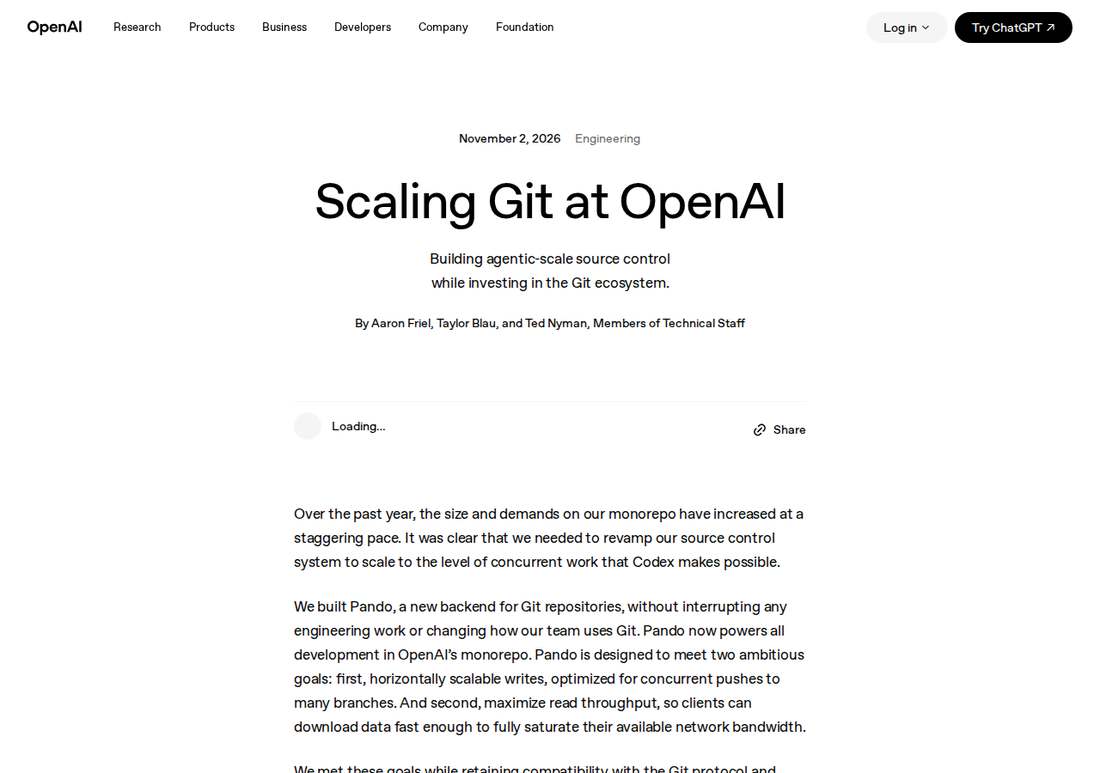
OpenAI published "Scaling Git at OpenAI" on its official engineering blog on November 2, unveiling Pando, its in-house Git backend. Pando keeps the Git protocol and client and rebuilds only the server side; it now carries development across the company's entire monorepo.
The driver was the parallel development volume created by Codex: one engineer can advance several changes at once, and each push triggers multiple CI jobs pulling the same commit. The old system suffered slower pushes and fetches and failed merges, with reliability at one point dropping below 90%.
Pando makes two trade-offs: it gives up repository-wide global consistency and per-client packfiles. Branch updates are coordinated independently, so cross-branch reads are not guaranteed a snapshot from the same moment; the server reuses stored packfiles for many clients to fetch, which means a client may download objects it already has.
Self-reported production figures: median push latency fell nearly fivefold (about 80%), the system serves close to 1 PB of Git data a day with single-hour packfile peaks above 57 TB, more than 99% of bytes come from local disk cache, and it has carried production traffic since April 2026.
Pando went from project start to production in about ten weeks. Its core was designed by a single engineer, a team of Codex agents handled implementation, a small number of engineers deployed it, and formal methods — Lean and TLA+ — were used to hunt bugs. Some client improvements have been contributed back to upstream Git.
WHY IT MATTERSAgents overloaded version control first
Pando's real signal is not Git itself, but a change in workload structure: one person plus multiple agent sessions behaves like a small team, multiplying short-lived branches and duplicate fetches. The old Git server's global coordination points became the bottleneck first — not Git's object model.
OpenAI's answer is to keep the interface and replace the server, so neither humans nor agents have to relearn their tools. Other large engineering organizations will copy this route: ask first about their own Git hosting's push latency and merge failure rates, rather than switching version control systems.
WHY IT MATTERSThe numbers are self-reported; the trade-offs are public
The near-fivefold latency cut, nearly 1 PB of daily traffic and the 57 TB peak hour all come from OpenAI's description of its own system, with no baseline for the old system, no hardware specifications and no error ranges. Outsiders cannot currently reproduce them, and the interactive architecture comparison is explicitly labeled a teaching model.
But the trade-offs themselves are public and verifiable: cross-branch reads are no longer snapshots from a single moment, and tools that depend on global snapshots need to assess that themselves. Whether Pando will be offered externally remains unknown; OpenAI says only that it is exploring ways to share it.
SIGNAL JUDGMENT — ANALYSISInterface unchanged, backend first
Tokenta Signal's judgment: the signal in Pando is not another internal system, but that once agents scale, the bottleneck in engineering infrastructure moves from model capability to the throughput of commits, fetches and merges. Keeping the Git interface and replacing only the server shows that the next round of infrastructure competition is about scaling agents invisibly — not about making humans change tools.
WHAT REMAINS UNCERTAINWhat Remains Uncertain
EVIDENCEEvidence
Confirmed by two sources: OpenAI's official engineering blog and independent reporting by ExplainX. Original links opened and verified.
PRIMARY SOURCESPrimary Sources
- OpenAI official engineering blog
https://openai.com/index/scaling-git-at-openai - ExplainX independent report
https://explainx.ai/blog/openai-pando-git-backend-codex-monorepo-5x-faster-pushes-petabyte-per-day-2026
RELATEDRelated Intelligence
- GlobalFoundries Posts Record 31.4% Margin as AI Packaging Deals Stack Up: $2B TSMC Pact, $21B U.S.-Japan Fabs
- Lambda Pledges $33.1 Billion for Alabama AI Campus, Revealing Itself as Project Red Clay's Tenant
- Kimi K3.1 Pro Weights Land on Hugging Face, Closing Moonshot's November 4 Promise
- Google Pledges $15 Billion for Malaysia Data Centers, With Clean Energy and Skills Attached